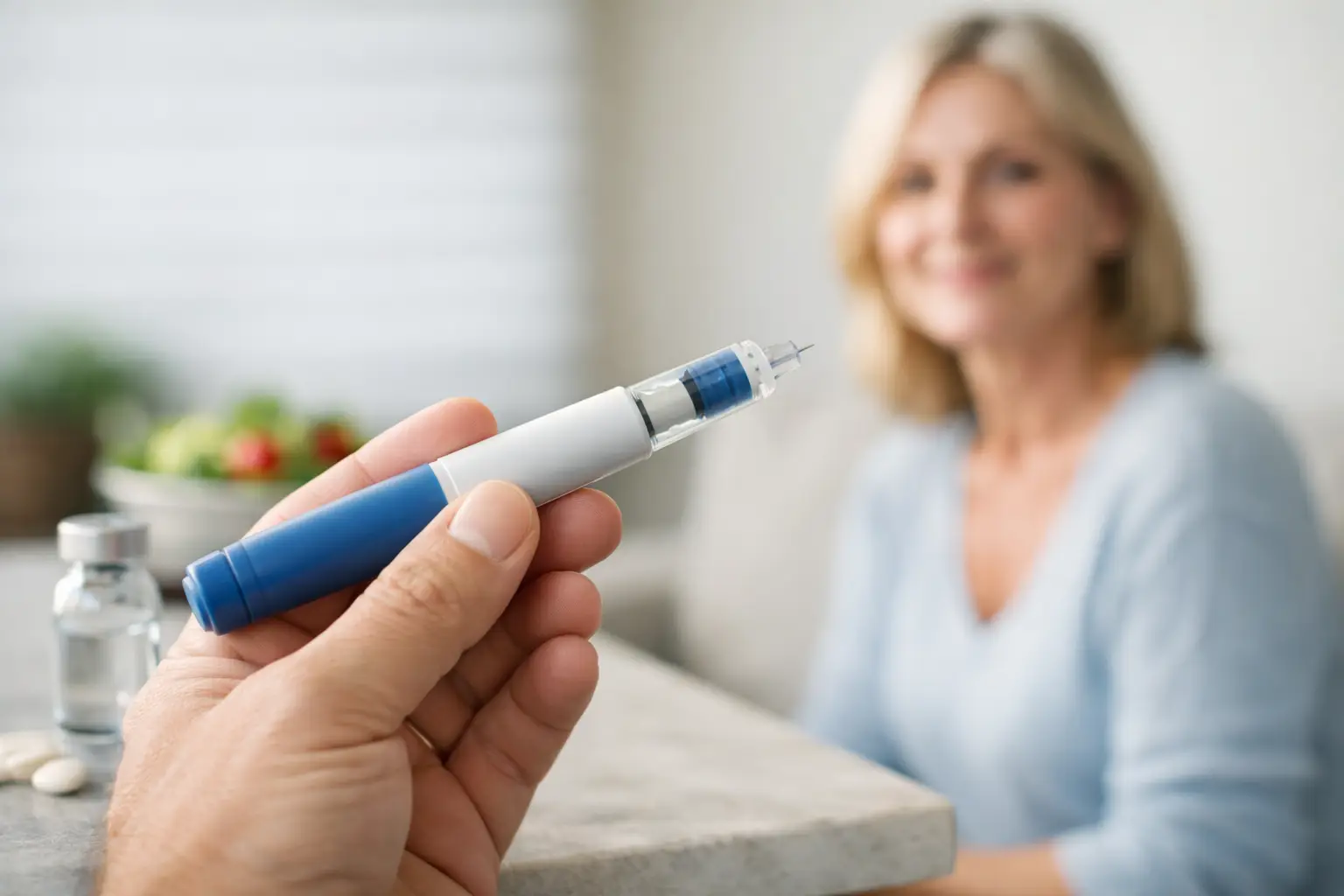


Hexarelin is an investigational growth-hormone-releasing peptide, not an FDA-approved weight-loss medication or general wellness treatment. Available research suggests it can affect growth hormone and related hormone pathways, but human evidence for meaningful, durable benefits is limited, and safety depends heavily on medical screening and monitoring.
Ready to find out if you qualify? Start Free Assessment — No payment required
What Hexarelin Is—and What It Is Not
Hexarelin is a synthetic peptide studied for its ability to stimulate growth hormone release. It belongs to a group of compounds often called growth-hormone secretagogues. Unlike an FDA-approved prescription drug with an established indication, dose, labeling, and post-market safety record, hexarelin does not have FDA approval for weight loss, anti-aging, muscle gain, or routine wellness use.
That distinction matters when reviewing hexarelin. A product page may describe a proposed mechanism or a compounded formulation, but those descriptions do not establish clinical effectiveness or FDA approval. Compounded medications are prepared under specific pharmacy or facility conditions and are not the same as, generic versions of, or equivalent to FDA-approved brand-name drugs. FDA does not evaluate compounded products for safety, effectiveness, or quality before marketing in the same way it evaluates approved drugs.
Hexarelin should therefore be approached as an investigational option requiring individualized medical review—not as a proven substitute for FDA-approved obesity treatments or a guaranteed way to change body composition.
How Hexarelin May Affect the Hormone Axis
The hypothalamic-pituitary-growth hormone axis regulates growth hormone release. The hypothalamus produces signaling hormones, the pituitary gland releases growth hormone, and the liver and other tissues respond partly through insulin-like growth factor 1, or IGF-1. Growth hormone secretion naturally varies by age, sleep, exercise, nutrition, sex, and metabolic health.
Research on hexarelin indicates that it can stimulate growth hormone release through pathways related to the growth-hormone secretagogue receptor. In laboratory and human physiology studies, effects may involve more than growth hormone alone. Depending on the study and participant characteristics, researchers have examined interactions with prolactin, adrenocorticotropic hormone, cortisol, glucose regulation, and other endocrine signals.
A hormone response is not the same as a clinically meaningful outcome. Raising growth hormone temporarily does not prove that hexarelin causes sustained fat loss, improves strength, reverses aging, or reduces health risk. The body may also respond differently over time, and pulsatile hormone biology makes isolated laboratory measurements difficult to interpret.
People considering a peptide should ask whether the proposed benefit has been demonstrated in well-controlled human studies using the same compound, route, dose, duration, and formulation being offered. If the answer is unclear, expectations should remain cautious.
What the Evidence Actually Shows
The evidence base for hexarelin is limited compared with FDA-approved therapies for obesity or endocrine disease. Published work has primarily examined physiology, hormone secretion, receptor activity, or small clinical research settings. These studies can help explain mechanism, but they may not establish long-term safety or patient-centered outcomes.
Important evidence limitations include:
- Limited evidence for durable weight loss or clinically important improvements in body composition.
- Few data addressing long-term use in people with obesity, diabetes, cardiovascular disease, or multiple medications.
- Uncertainty about whether short-term hormone changes translate into better health or quality of life.
- Potential differences between research preparations and compounded products.
- Limited information about dose-ranging, treatment duration, discontinuation effects, and rare adverse events.
For comparison, people evaluating evidence-based medical weight management can review online weight-loss care, semaglutide safety, and semaglutide versus tirzepatide. Those treatments have different mechanisms, indications, evidence standards, and contraindications; they should not be treated as interchangeable with hexarelin.
Evidence-quality checklist
| Question | Why it matters | What a careful review should say | |---|---|---| | Was the study conducted in humans? | Animal or laboratory findings may not predict patient outcomes. | Human evidence should be identified separately from preclinical research. | | Was the study randomized and controlled? | Controls help distinguish treatment effects from expectation or natural variation. | Small uncontrolled studies provide weaker evidence. | | Did it measure patient-centered outcomes? | Hormone changes do not automatically mean better health. | Look for validated outcomes such as weight, function, glucose markers, or quality of life. | | Was follow-up long enough? | Short studies may miss delayed or cumulative harms. | Long-term safety remains uncertain when follow-up is brief. | | Was the preparation clearly described? | Formulation and quality can affect exposure. | Do not assume findings for a research product apply to every compounded product. |
The most authoritative sources for checking claims include FDA safety communications and compounding guidance, NIH/PubMed-indexed research, peer-reviewed journals, and official prescribing information for approved alternatives. A provider should be able to explain which claims are supported by clinical evidence and which remain theoretical.
Safety Uncertainty and Potential Concerns
Because hexarelin is not FDA-approved for marketed wellness uses, its complete safety profile is not established. Possible concerns may relate to its effects on hormone signaling, glucose metabolism, fluid balance, injection practices, and product quality. A person may also have an underlying condition that makes hormone stimulation inappropriate or makes a new symptom harder to interpret.
Potential issues that warrant medical attention may include swelling, joint discomfort, headaches, numbness or tingling, changes in blood sugar, increased hunger, sleep changes, or injection-site reactions. These symptoms are not proof that hexarelin caused a problem, and they should not be managed by changing the dose without clinician guidance.
Additional caution may be appropriate for people with a history of cancer, unexplained masses, pituitary or hypothalamic disorders, diabetes or prediabetes, sleep apnea, significant heart disease, uncontrolled hypertension, pregnancy, breastfeeding, or use of medications affecting glucose or endocrine function. This list is not exhaustive. A clinician must decide whether evaluation is appropriate for a particular person.
Product handling is another safety issue. A compounded injectable may carry risks involving sterility, potency, storage, labeling, shipping, and administration technique. Patients should know the dispensing pharmacy, the formulation and concentration, the expiration or beyond-use date, storage requirements, and what to do if the product appears damaged or arrives warm. A legitimate process should not discourage questions about sourcing.
Hexarelin Compared With Approved Weight-Loss Options
Hexarelin and FDA-approved anti-obesity medications are not direct substitutes. They act through different biological pathways and have different clinical evidence, eligibility rules, monitoring requirements, and regulatory status.
For example, semaglutide and tirzepatide are prescription medicines with specific FDA-approved indications and official labeling. Their use still requires screening, informed consent, and follow-up, and not every person is eligible. Hexarelin, by contrast, lacks an FDA-approved indication for weight loss and has substantially less evidence for that goal.
A comparison should focus on the following rather than on marketing promises:
- Regulatory status and approved indication.
- Quality and consistency of the product supplied.
- Evidence for sustained outcomes.
- Known contraindications, warnings, and interactions.
- Monitoring and follow-up plan.
- Total cost, including consultation, medication, supplies, and laboratory testing.
- What happens if the treatment is ineffective or causes adverse effects.
Patients in Florida and New York can review available programs and pricing, then discuss whether an approved treatment or another medically appropriate option better fits their goals.
Why Provider Review Matters
Provider review is especially important when evidence is limited. A qualified clinician should take a medical history, review medications and supplements, assess relevant symptoms and goals, and determine whether a proposed treatment is appropriate. Depending on the situation, the clinician may recommend laboratory testing or referral for evaluation of endocrine, metabolic, sleep, cardiovascular, or other conditions.
A responsible review should also clarify what is known and unknown. Ask:
- Is hexarelin FDA-approved for the goal being discussed?
- What human studies support this use, and how strong are they?
- What formulation, concentration, route, and dosing schedule are being considered?
- Which symptoms should prompt urgent care or a treatment pause?
- What monitoring is planned, and who reviews results?
- Which pharmacy prepares the product, and how is sterility addressed?
- What are the alternatives, including FDA-approved options?
- What is the complete expected cost?
A provider should not promise a specific amount of weight loss, describe an unapproved peptide as risk-free, or imply that a compounded product has FDA approval. If a treatment is offered, the patient should receive clear instructions and a way to contact the care team. EdenRx’s assessment can help determine whether a clinician-led discussion is appropriate; eligibility is not guaranteed and results vary.
Built from Eden Med Spa — real patients, real treatments.
Practical Questions About Cost, Access, and Follow-Up
The advertised price of a peptide program may not include consultation, laboratory testing, supplies, shipping, follow-up visits, or management of side effects. Before starting, request an itemized explanation of what is included and whether ongoing monitoring is required.
Access rules also differ by state and clinical circumstances. EdenRx serves eligible patients in Florida and New York through provider-reviewed telehealth processes. Telehealth does not remove the need for an accurate history, identity verification, medication review, or appropriate follow-up. A clinician may decide that another treatment, an in-person examination, or additional testing is safer.
Do not purchase an injectable peptide from an unverified online source or use a product labeled for research only. The label, concentration, sterility, and contents may not be reliable, and self-directed dosing can delay care for a serious condition.
Considering a medically reviewed plan? Explore the assessment to discuss eligibility, alternatives, and next steps. No payment is required to begin.
Evidence and Sources to Review
The following source types are appropriate for evaluating hexarelin claims:
- FDA resources on compounded drugs, drug approval, and compounded-product risks.
- NIH and PubMed records for peer-reviewed human and preclinical studies of hexarelin, growth-hormone secretagogues, and endocrine effects.
- Peer-reviewed endocrinology and pharmacology literature describing the growth-hormone secretagogue receptor and hypothalamic-pituitary-growth hormone axis.
- Official prescribing information for FDA-approved weight-management medicines when making comparisons.
These sources support a cautious interpretation: hexarelin has biologic activity documented in research, but biologic activity is not proof of an approved or effective weight-loss therapy. Because formulations, dosing, and patient populations vary, a clinician should interpret individual studies rather than relying on isolated claims or testimonials.
Frequently Asked Questions
Is hexarelin FDA-approved for weight loss?
No. Hexarelin is not FDA-approved for weight loss or general wellness use. A compounded preparation should not be described as FDA-approved, and compounding does not establish the effectiveness of the compound for a particular goal.
Does hexarelin cause weight loss?
There is not enough high-quality evidence to conclude that hexarelin provides reliable, durable weight loss. It may affect growth-hormone signaling, but a hormone response does not prove meaningful fat loss or improved health outcomes.
Is hexarelin safe?
Its complete long-term safety profile is unknown. Potential concerns may involve endocrine effects, glucose regulation, fluid retention, injection reactions, and product quality. A provider should review medical history, risks, alternatives, and monitoring before treatment.
Is compounded hexarelin the same as an FDA-approved medication?
No. Compounded products are not the same as, generic versions of, or equivalent to FDA-approved brand-name drugs. FDA does not evaluate compounded products for safety, effectiveness, or quality before marketing in the same way it evaluates approved medicines.
What should I ask a provider before considering hexarelin?
Ask about the evidence for your specific goal, regulatory status, formulation and pharmacy, dosing, possible adverse effects, contraindications, laboratory monitoring, total cost, alternatives, and follow-up plan. You should also ask what happens if the treatment does not help or causes symptoms.
Can people in Florida or New York request a review?
Eligible adults in Florida and New York may request a provider-reviewed telehealth assessment through EdenRx. Eligibility is determined individually, and a clinician may recommend another option or in-person care when appropriate.
Conclusion
Hexarelin’s proposed hormone-axis mechanism is scientifically relevant, but its evidence for weight loss and wellness remains limited, and its long-term safety is uncertain. If you are considering it, prioritize transparent evidence, careful screening, verified product handling, realistic expectations, and ongoing provider follow-up over testimonials or guarantees.
Start your free assessment to discuss whether a medically reviewed option may be appropriate. No payment is required to begin, eligibility is not guaranteed, and results vary.