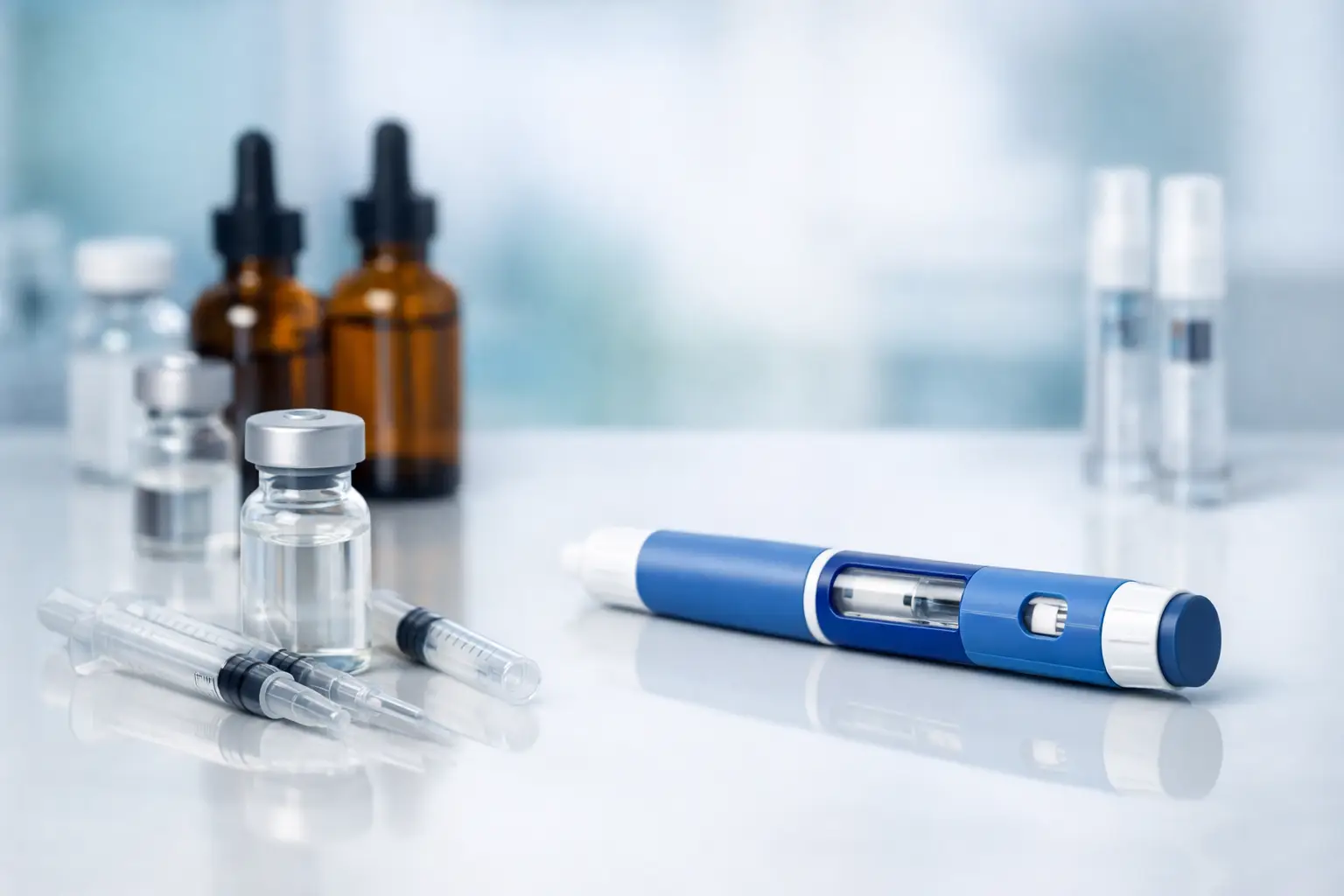


TB-500 is a synthetic peptide associated with thymosin beta-4 research, but strong human evidence for marketed healing, recovery, or performance claims is lacking. Because TB-500 is not an FDA-approved treatment for these uses and product quality can vary, an individualized review with a qualified clinician is important before considering it.
Ready to find out if you qualify? Start Free Assessment — No payment required
What Is TB-500?
TB-500 is a laboratory-produced peptide commonly marketed as a fragment or analog related to thymosin beta-4, a naturally occurring peptide involved in cellular processes. Promotional materials often discuss cell migration, tissue remodeling, inflammation, blood-vessel formation, and wound-repair pathways. These proposed mechanisms are biologically interesting, but a plausible mechanism does not establish that an injectable product improves healing or produces a reliable clinical outcome in people.
The name also creates an important identification issue. Products labeled "TB-500" may differ in sequence, formulation, concentration, sterility, storage requirements, and source. A product sold online or through an unverified supplier should not be assumed to match a research formulation or a product used in a peer-reviewed study.
For an overview of the compound, its potential uses, and eligibility considerations, see EdenRx's TB-500 guide. That page is the hub for this topic; this article focuses specifically on evidence quality, safety uncertainty, and provider review.
TB-500 Evidence: What Research Actually Shows
The evidence is best understood in layers:
| Evidence type | What it can show | What it cannot prove | |---|---|---| | Cell or laboratory research | How a peptide may affect cells or signaling pathways | That a treatment is safe or effective in people | | Animal research | Possible effects in a living organism and clues about dosing or toxicity | That the same effect, dose, or risk applies to humans | | Early human studies | Preliminary tolerability or signals of activity in a defined population | Broad effectiveness, long-term safety, or suitability for self-treatment | | Large controlled trials | Comparative benefits and harms under monitored conditions | That every patient will respond or that a product is appropriate outside its studied use |
Much of the publicly discussed support for thymosin beta-4-related compounds comes from preclinical work. Studies involving cells and animals can help researchers form hypotheses about repair pathways, but they do not establish that TB-500 heals injuries, reverses disease, prevents complications, or improves athletic recovery in humans.
Human evidence for products specifically marketed as TB-500 remains limited and does not support treating it as an established therapy. Readers should also distinguish research involving thymosin beta-4 from claims about TB-500: related compounds are not automatically interchangeable, and findings from one formulation cannot be transferred without evidence.
The FDA explains that compounded drugs are not FDA-approved and are not reviewed by the agency for safety, effectiveness, or quality before marketing in the same way as approved drugs. A compounded product should therefore not be described as an FDA-approved TB-500 treatment or as a generic version of an FDA-approved medicine.
Safety, Side Effects, and Unknowns
The most responsible safety summary is that important risks and unknowns remain. Potential concerns may include injection-site reactions, contamination, incorrect concentration, allergic reactions, interactions with other therapies, and adverse effects that are not recognized until a product is used by larger numbers of people. Long-term risks may be especially difficult to assess when high-quality human studies are unavailable.
A provider may also need to consider whether a symptom attributed to an injury or inflammation could represent a condition requiring established diagnosis and treatment. Delaying evaluation of infection, fracture, tendon rupture, cancer, vascular disease, or another serious problem can create more risk than the peptide itself.
Discuss all medicines, supplements, allergies, surgeries, pregnancy or breastfeeding status, bleeding risks, immune conditions, liver or kidney disease, and active infections during screening. Do not inject a product obtained from an anonymous website, social-media seller, or unverified source. Do not change a prescribed treatment because of online peptide claims.
The following checklist can help identify unanswered questions:
- Is the product legally available for the proposed use?
- Is it FDA-approved for that indication? If not, is the status clearly explained?
- What is the exact ingredient, concentration, route, storage requirement, and beyond-use date?
- Which pharmacy prepared it, and what verification is available?
- What symptoms require urgent medical care?
- How will the clinician monitor response, side effects, and the underlying condition?
- What is the plan if there is no benefit or if symptoms worsen?
Regulatory and Product-Quality Considerations
FDA approval is indication-specific. A substance may be studied in research without being approved for routine treatment, and a compounded medication may be prepared for an individual prescription without being FDA-approved. These distinctions matter when evaluating online claims about TB-500.
Compounding can be appropriate in certain clinical circumstances, but it introduces quality and consistency questions that should be addressed openly. Patients should receive understandable information about the source, labeling, administration instructions, storage, adverse-event reporting, and follow-up process. A provider should never promise a particular result or imply that a compounded peptide has the same evidence, regulatory review, or quality controls as an FDA-approved product.
If you are primarily seeking evidence-based medical weight management rather than an experimental recovery peptide, EdenRx also provides information about online weight-loss care. FDA-approved options such as semaglutide or tirzepatide have a different evidence and regulatory profile than TB-500, although suitability still depends on medical history. See is semaglutide safe and semaglutide vs. tirzepatide for related education.
Why Provider Review Matters
A provider review is more than a questionnaire. It should establish what the patient is trying to address, whether the symptoms have been evaluated, and whether an evidence-supported option exists. It should also identify contraindications, medication interactions, realistic expectations, and a follow-up plan.
For patients in Florida and New York, a provider-reviewed telehealth process may help organize this assessment, but telehealth does not eliminate the need for appropriate diagnosis or in-person care when indicated. A licensed clinician should determine whether the requested therapy is appropriate, whether more information is needed, and whether referral or urgent evaluation is safer.
A useful review should address:
- The goal: injury evaluation, general wellness, body composition, weight management, or another concern.
- The diagnosis: whether a clinician has identified the underlying problem.
- The evidence: what is known about the proposed peptide for that specific goal.
- The risk profile: allergies, active illness, pregnancy status, medications, and relevant medical history.
- The product: formulation, pharmacy, instructions, storage, and labeling.
- The monitoring plan: follow-up timing, adverse effects, and criteria for stopping or escalating care.
A responsible clinician may decide that TB-500 is not appropriate. That outcome is part of safe care, not a failure of the consultation.
What Reliable Sources Say About Evidence
Authoritative sources should be prioritized over testimonials and marketing pages. The FDA's consumer and compounding information explains that compounded drugs are not FDA-approved and are not evaluated by the agency for safety, effectiveness, or quality before marketing in the same manner as approved drugs. FDA materials also emphasize the importance of discussing compounded medications with a health care professional and reporting concerns.
PubMed and NIH-indexed literature include preclinical research involving thymosin beta-4-related biology, including cellular migration and tissue-repair pathways. Those publications can help explain a proposed mechanism, but they should not be presented as proof that TB-500 provides a healing benefit for people. When reviewing a paper, check the exact compound, species, route, dose, endpoints, study design, and whether the work was conducted in humans.
For approved weight-management medicines, the FDA prescribing information and clinical trial literature provide a separate evidence base. Those sources should not be used to imply that TB-500 has comparable approval or clinical support. Product-specific evidence always matters.
EdenRx's approach is to explain uncertainty rather than make healing guarantees. Results vary, and eligibility is determined through clinical review.
Built from Eden Med Spa — real patients, real treatments.
Frequently Asked Questions
Is TB-500 FDA-approved?
TB-500 is not FDA-approved as a treatment for healing, injury recovery, inflammation, athletic performance, or general wellness. A compounded product should not be described as FDA-approved or as equivalent to an approved medicine.
Does TB-500 have human clinical evidence?
Human evidence for products specifically marketed as TB-500 is limited. Much of the discussion is based on laboratory or animal research, and those findings do not establish safety or effectiveness in people.
Can TB-500 heal an injury?
There is no reliable basis for guaranteeing that TB-500 will heal an injury. An injury may require diagnosis, imaging, physical therapy, surgery, medication, or urgent treatment. A clinician should evaluate the underlying problem.
Is TB-500 safe to inject?
Its safety profile is not fully established, especially for long-term or unsupervised use. Risks may include contamination, dosing errors, injection reactions, allergic responses, interactions, and unknown effects. Product source and provider monitoring are important.
How should I evaluate a TB-500 provider?
Ask whether the clinician is licensed for your location, explains the evidence and regulatory status, reviews your medical history, identifies alternatives, verifies the pharmacy and product information, and provides follow-up and emergency guidance. Be cautious of guaranteed results or claims that a compounded product is the same as an FDA-approved drug.
How can I start a review with EdenRx?
You can begin with the free assessment. If appropriate, a provider can review your goals and health history. Information about programs and pricing is also available. Eligibility is not guaranteed, and some concerns may require in-person care.
Conclusion
TB-500 has a biologically plausible research story, but that is not the same as proven human effectiveness. The current evidence and regulatory uncertainty make provider review, product transparency, diagnosis, and follow-up essential. If you are considering TB-500 in Florida or New York, start with an individualized assessment rather than relying on testimonials or healing guarantees.
Ready to find out if you qualify? Start Free Assessment — No payment required