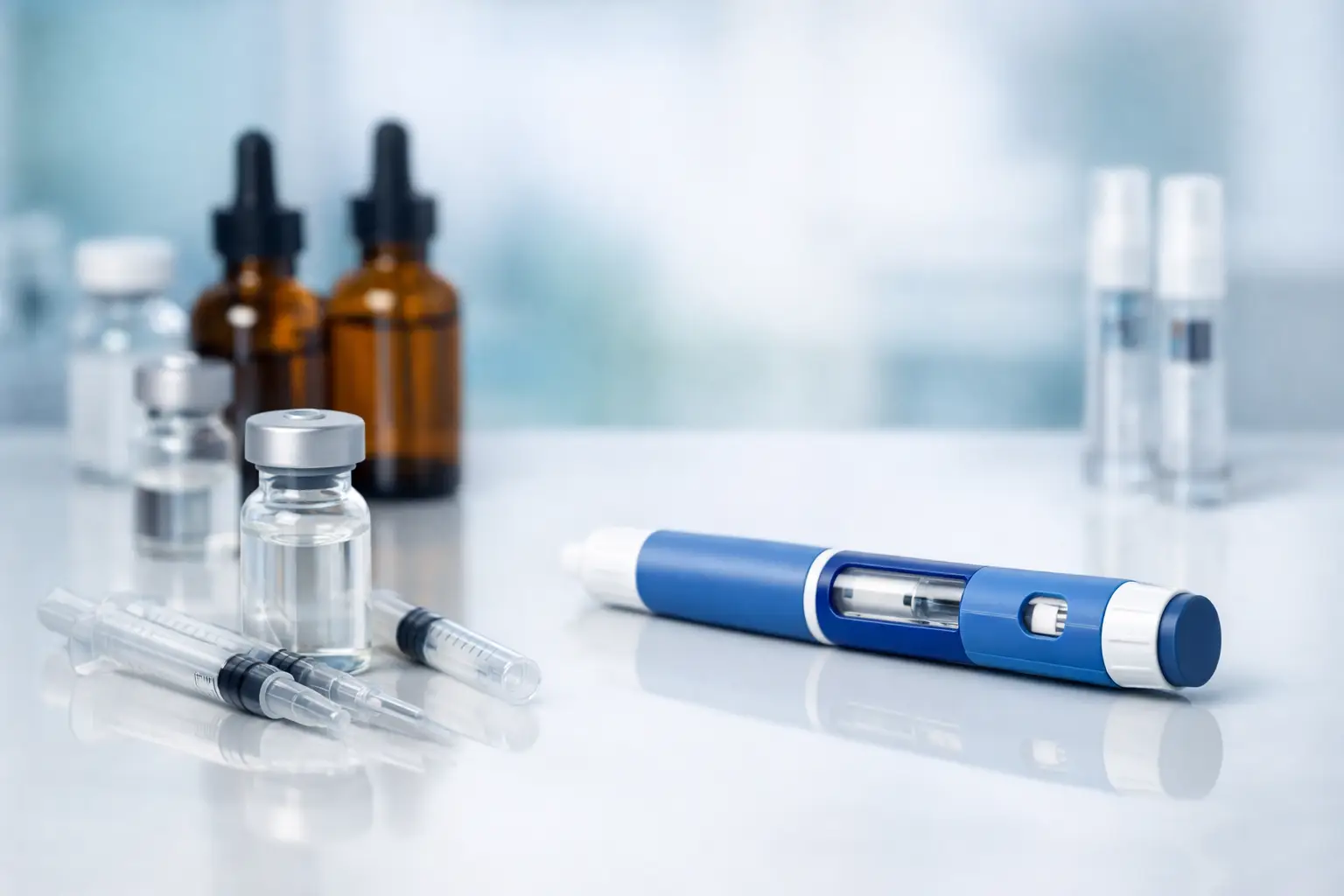


BPC-157 and TB-500 are not FDA-approved medicines for wellness, injury recovery, or other marketed uses in the United States. A compounded product containing either peptide is not FDA-approved, and compounding does not establish that it is safe, effective, or equivalent to an approved medicine.
Ready to find out if you qualify? Start Free Assessment — No payment required
What does the FDA status mean?
FDA approval applies to a specific drug product for particular uses after the agency reviews evidence about its quality, safety, and effectiveness. As of this article’s publication, FDA has not approved BPC-157 or TB-500 as drugs for the commonly promoted wellness, tissue-repair, or athletic-recovery purposes. Neither should be described as an FDA-approved treatment for those purposes.
The terms “investigational,” “compounded,” and “off-label” do not mean the same thing. Investigational use refers to research or development, subject to applicable requirements. Compounding means a pharmacy combines, mixes, or alters ingredients to make a medication for a particular patient under applicable federal and state rules. Off-label use means a clinician prescribes an FDA-approved drug for a use, dose, or patient group not specified in its FDA-approved labeling. Since BPC-157 and TB-500 are not FDA-approved drugs, their use is not accurately described as off-label use of an FDA-approved medicine.
For product-specific information and the distinction between a peptide product and its regulatory status, see EdenRx’s BPC-157 and TB-500 overview.
| Term | What it means | What it does not mean | |---|---|---| | FDA-approved drug | FDA has approved a specific product for specified uses based on its review | Approval of every use, formulation, or seller of a related substance | | Compounded medication | A pharmacy prepares a medication under applicable compounding rules | FDA approval, proof of effectiveness, or automatic equivalence to a commercial drug | | Investigational product | A product being studied or developed under applicable research requirements | A proven treatment available for routine use | | Off-label prescribing | Use of an FDA-approved medicine outside its labeled indication, when clinically appropriate | A way to confer approval on an unapproved substance |
What are BPC-157 and TB-500?
BPC-157 is a synthetic peptide based on a sequence associated with a protein found in gastric juice. TB-500 is a name used in some commercial settings for products described as related to thymosin beta-4, a naturally occurring peptide involved in cellular processes. Names and formulations in the marketplace can vary, so the label alone may not establish a product’s identity, purity, strength, or composition.
These substances are promoted online for claims involving healing, inflammation, mobility, or exercise recovery. Such marketing claims should not be treated as established clinical benefits. A proposed biological role or an effect observed in laboratory research does not establish that a product improves a health outcome in people.
Proposed mechanisms are not the same as demonstrated treatment effects. Researchers have studied biological pathways related to cell migration, tissue response, or other processes, but a plausible mechanism cannot answer whether a particular peptide product is safe, effective, properly dosed, or appropriate for a patient.
EdenRx’s peptide product information explains the product category; a provider should separately assess whether any treatment is appropriate for an individual’s needs and medical history.
What does the evidence show—and not show?
The evidence base for BPC-157 and TB-500 is limited, particularly for establishing safety and effectiveness in people for the uses commonly advertised. Preclinical findings, including laboratory or animal research, can help generate questions for further study. They do not establish a reliable dose, long-term safety, or meaningful clinical benefit in humans.
A careful evidence review asks whether studies enrolled people, used a well-described product and dose, included an appropriate comparison group, measured outcomes that matter to patients, and were independently replicated. For these peptides, consumers may encounter strong claims without that level of evidence. Lack of robust human evidence does not prove that an effect is impossible; it means the effect and risks are not established well enough to make confident treatment claims.
The FDA has raised concerns about bulk drug substances used in compounding, including BPC-157, and has discussed potential safety risks such as immunogenicity, peptide-related impurities, and difficulties in characterizing the active ingredient. These concerns are reasons for caution, not proof that every compounded preparation causes harm. They also illustrate why a product’s source and manufacturing controls matter.
TB-500 is not an FDA-approved treatment for the marketed recovery or wellness uses described online. Consumers should not infer that research on thymosin beta-4, or on a different formulation or route, establishes the safety or effectiveness of a product sold as TB-500.
Authoritative sources
- The FDA’s Bulk Drug Substances Used in Compounding That May Present Significant Safety Risks page identifies substances that may present safety risks when used in compounding and describes the agency’s concerns, including for BPC-157.
- The FDA’s Human Drug Compounding information explains how compounding is regulated and clarifies that compounded drugs are not FDA-approved.
- The FDA’s Compounding and the FDA: Questions and Answers describes the distinction between compounded drugs and FDA-approved drugs.
Regulatory information can change. Patients and clinicians should consult current FDA materials and applicable state rules rather than relying on a seller’s description or a social-media post.
Compounded products: important distinctions and questions
Compounding serves legitimate medical purposes in certain circumstances, such as when a patient needs a formulation or ingredient combination that is not commercially available and a prescriber determines that a compounded medication is appropriate. Federal law and state requirements govern who may compound and under what conditions. A compounded product is not subject to FDA premarket approval in the same way as an FDA-approved drug.
That distinction does not mean every compounded prescription is unlawful or unsuitable. It does mean that the product has not received FDA approval as a finished drug for a particular indication. Do not assume a compounded peptide is a generic version of an approved medicine, or that it has the same evidence, manufacturing review, labeling, or FDA oversight as an approved product.
Before considering any compounded medication, patients can ask:
- What is the exact ingredient, formulation, route, and intended purpose?
- Why is compounding being considered rather than an FDA-approved option?
- Which pharmacy will prepare it, and what quality controls apply?
- What is known—and unknown—about risks, interactions, and monitoring?
- What should I do if I experience a possible adverse reaction?
- Is this treatment appropriate given my diagnoses, medications, pregnancy status, or other health factors?
Avoid products sold with guarantees, secret formulas, claims to cure disease, or pressure to bypass a medical evaluation. Online availability does not establish regulatory approval, product quality, or clinical suitability.
Safety uncertainty and provider review
Safety cannot be inferred from a peptide’s presence in the body, a proposed mechanism, or use by other people. Potential concerns include uncertain product identity and purity, contamination or impurities, immune reactions, interactions, and unknown effects with repeated or long-term exposure. The specific risks may depend on the formulation, route, dose, source, and patient. Reliable risk estimates may not be available.
Seek urgent care for severe symptoms such as trouble breathing, facial or throat swelling, fainting, or rapidly worsening symptoms after using any medication or product. For non-emergency concerns, contact a qualified clinician and share the package, label, source, and timing of use. Do not stop a prescribed medicine or substitute a peptide without discussing it with your clinician.
Why Provider Review Matters
A provider review should start with the health concern and available evidence—not with a promised result. A clinician can review medical history, current medicines, allergies, and potential contraindications; explain the difference between an approved treatment and a compounded product; and discuss alternatives, uncertainty, and follow-up. Provider review does not make an unapproved product FDA-approved, and it cannot eliminate unknown risks.
EdenRx offers telehealth services for eligible patients in Florida and New York. A clinical assessment can help determine whether a program is appropriate; it does not guarantee a prescription or a particular outcome. To learn about other care options, visit online weight-loss care, review the GLP-1 weight-loss program, or read who may qualify for weight-loss medication. These are separate care pathways and are not evidence that BPC-157 or TB-500 is an established weight-loss treatment.
Interested in a clinician-reviewed next step? Start your free assessment to share your goals and health history. Eligibility and treatment decisions depend on provider review.
Frequently Asked Questions
Is BPC-157 FDA-approved?
No. FDA has not approved BPC-157 for marketed wellness, injury-recovery, or other therapeutic uses. A product being sold or compounded does not change that status.
Is TB-500 FDA-approved?
No. TB-500 is not FDA-approved as a treatment for the recovery, healing, or wellness uses commonly advertised. Research involving a related peptide does not establish approval or effectiveness of a product sold under this name.
Does a prescription mean a compounded peptide is FDA-approved?
No. A prescription and pharmacy compounding do not equal FDA approval. Compounded medications are prepared under applicable rules but are not FDA-approved finished drugs, and their benefits and risks may not have been evaluated by FDA in the same way as those of an approved drug.
Is BPC-157 or TB-500 use “off-label”?
Not in the usual regulatory sense. Off-label prescribing refers to an FDA-approved drug used outside its approved labeling. Because BPC-157 and TB-500 are not FDA-approved drugs, describing their use as off-label can be misleading.
Are there human studies proving these peptides work?
The available evidence does not establish reliable safety and effectiveness for the wellness or recovery claims commonly promoted. Preclinical research may inform future studies, but it cannot by itself prove benefit in people. Ask a clinician to explain the evidence for the specific product, formulation, and intended use.
Can EdenRx prescribe BPC-157 or TB-500?
Treatment availability and eligibility depend on current clinical practice, applicable regulations, and provider review. An assessment does not guarantee a prescription. Patients in Florida and New York can review program details and pricing or explore available programs.
Conclusion
The clearest answer to “BPC-157 / TB-500 FDA status” is that neither is FDA-approved for the wellness and recovery uses commonly marketed. Compounding is a distinct practice, not a shortcut to FDA approval, and proposed mechanisms or early research are not proof of clinical benefit. Discuss the evidence, product source, risks, and alternatives with a qualified provider before making a decision.
Built from Eden Med Spa — real patients, real treatments.
For a provider-reviewed starting point, begin the free assessment. Care is available to eligible patients in Florida and New York; results vary, and no treatment outcome is guaranteed.