


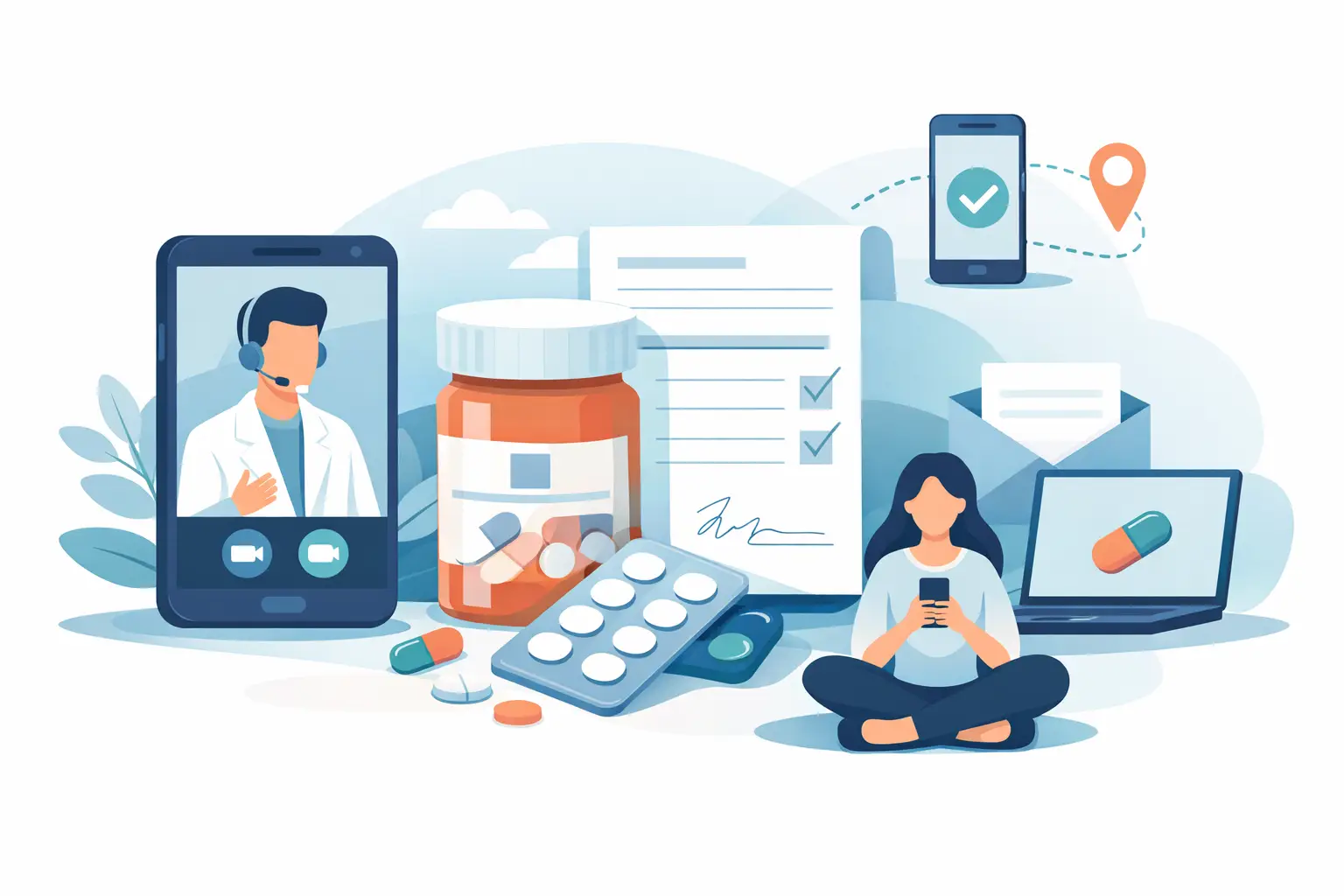
If you're searching for how to get prescription without doctor appointments, what you usually want is not to skip medical review. You want to skip the waiting room, the phone tag, and the extra steps. That distinction matters, because in the US, legitimate prescriptions still require a licensed clinician's evaluation. The good news is that evaluation no longer has to happen the old way.
For many common health needs, the fastest path is a virtual one. Online care has changed what prescription access looks like, especially for adults who want something simpler, more private, and easier to fit into a busy week. But there are limits, and knowing those limits can save you time and lower your risk.
How to get prescription without doctor visits
The short answer is this: you generally cannot legally get a prescription without a doctor's authorization or another licensed prescriber's approval. What you can do is get a prescription without going to an in-person doctor's office.
That usually happens through telehealth. Instead of scheduling a traditional appointment, you complete an online intake, share your symptoms and health history, and a licensed provider reviews your case. If the treatment is appropriate, they can issue a prescription and send it to a pharmacy or help arrange fulfillment.
For straightforward conditions, this can be much faster than the standard route. Think common issues like certain skin concerns, urgent but uncomplicated infections, birth control, hair loss, erectile dysfunction, or ongoing medication management when clinically appropriate. The exact options depend on state rules, the medication involved, and your medical history.
What actually works instead of trying to bypass a doctor
People often use the phrase how to get prescription without doctor because they are trying to avoid friction, not the prescription requirement itself. In practice, there are a few legitimate paths.
Telehealth platforms are the most obvious one. They replace the office visit with a digital intake and, when needed, a video or messaging-based consultation. This is often the easiest option if your condition is common, non-emergency, and easy to assess remotely.
Another route is ongoing care through a licensed nurse practitioner or physician assistant, depending on the service and state law. Many people say "doctor" when they really mean any prescriber. In reality, several types of licensed clinicians can prescribe medications.
There are also refill-focused services, but these are more limited than people expect. If you have an existing prescription and a stable treatment plan, a provider may be able to review your history and authorize a continuation. If your medication needs closer monitoring, controlled-substance rules, lab work, or a new diagnosis, the process becomes less simple.
When telehealth is a good fit
Telehealth works best when your symptoms are clear, your health history is straightforward, and the treatment does not require a physical exam, imaging, or immediate testing. It is especially useful for adults who already know what issue they are dealing with and want a faster way to handle it.
That said, convenience has boundaries. If you have chest pain, trouble breathing, severe swelling, signs of stroke, suicidal thoughts, major allergic reactions, or rapidly worsening symptoms, telehealth is not the right first step. You need urgent or emergency care.
Telehealth can also be less useful when a provider needs to listen to your lungs, examine an injury, check your abdomen, or confirm a diagnosis with an in-person test. A good digital care experience should tell you that clearly instead of forcing a bad fit.
How the online prescription process usually works
Most legitimate services follow a predictable process. First, you choose the condition or treatment category. Then you complete a medical questionnaire covering symptoms, allergies, current medications, past diagnoses, and relevant risk factors.
After that, a licensed provider reviews the information. Sometimes that review is enough. Other times, you may need a short video visit, a phone call, or follow-up questions through secure messaging. If the provider decides the medication is appropriate, they send the prescription to a pharmacy. If not, they should explain why and point you toward a better care setting.
This is the part many people miss: a real evaluation still happens. It is simply compressed into a digital format that feels more efficient. That's why the better question is not really how to get prescription without doctor. It's how to get a prescription without the hassle of a traditional doctor visit.
What you cannot legally or safely do
You should be wary of any site that promises prescription medication with no medical review, no licensed prescriber, or no verification of your health information. Those offers are not shortcuts. They are red flags.
A legitimate prescription service will ask for real medical details, confirm your identity, and disclose who is reviewing your case. It will not guarantee approval before assessing you. It also will not treat every medication the same way.
Controlled substances are where many consumers run into confusion. Rules are stricter, and for good reason. Certain medications have abuse potential, require close monitoring, or trigger additional federal and state requirements. Even when telehealth access is allowed, it may involve extra verification, follow-up visits, or restrictions based on your location.
Imported medications, social media sellers, and "online pharmacies" that skip prescriptions entirely are another major risk. Even when the packaging looks real, the contents may not be. The problem is not just legality. It is safety, dosing, contamination, and counterfeit supply.
How to tell if an online prescription service is legitimate
The safest platforms make the process feel simple without making it feel vague. You should be able to see that licensed providers are involved, what conditions are treated, what states are supported, and how prescriptions are issued.
Pricing should be understandable. Privacy practices should be clear. The service should ask questions that feel medically relevant, not superficial. If everything looks designed to rush you straight to checkout with no clinical context, that is a sign to slow down.
It also helps to look for realistic expectations. Trustworthy services do not promise that everyone gets approved. They explain that eligibility depends on your health profile, your symptoms, the medication, and state law. For adults in states like Florida and New York, availability may differ based on local prescribing rules and provider licensure.
Why some prescriptions are easy to get online and others are not
Not all medications carry the same level of risk. That is why digital access can feel quick for some treatments and much more layered for others.
Low-risk, well-understood medications for common conditions are often the easiest to handle remotely. Medications that affect blood pressure, mental health, hormones, infection management, or chronic disease may still be available through telehealth, but they often require stronger screening. Some need lab results. Some require prior records. Some are simply not appropriate without an in-person exam.
This is not inefficiency for its own sake. It is the trade-off between convenience and safe prescribing. The best services are built to reduce unnecessary friction, not remove clinical judgment.
A smarter way to think about prescription access
If your goal is speed, focus on preparation. Have your medication list ready, know your allergies, be honest about your symptoms, and keep your pharmacy details nearby. That alone can make an online visit move much faster.
It also helps to be specific about what you want. Asking for a certain medication can be fine, but asking for help with a condition is usually more effective. Providers are there to decide what treatment fits, and sometimes that turns out to be a different medication, a different dose, or no prescription at all.
For people who want a cleaner, more modern path to treatment, digital care can remove a lot of the friction that made prescription access feel harder than it needed to be. A service like EdenRx fits best when you want that process to feel direct, legitimate, and easier to manage from your phone or laptop.
The real shortcut is not getting around medical care. It is choosing a format that respects your time while still protecting your health.