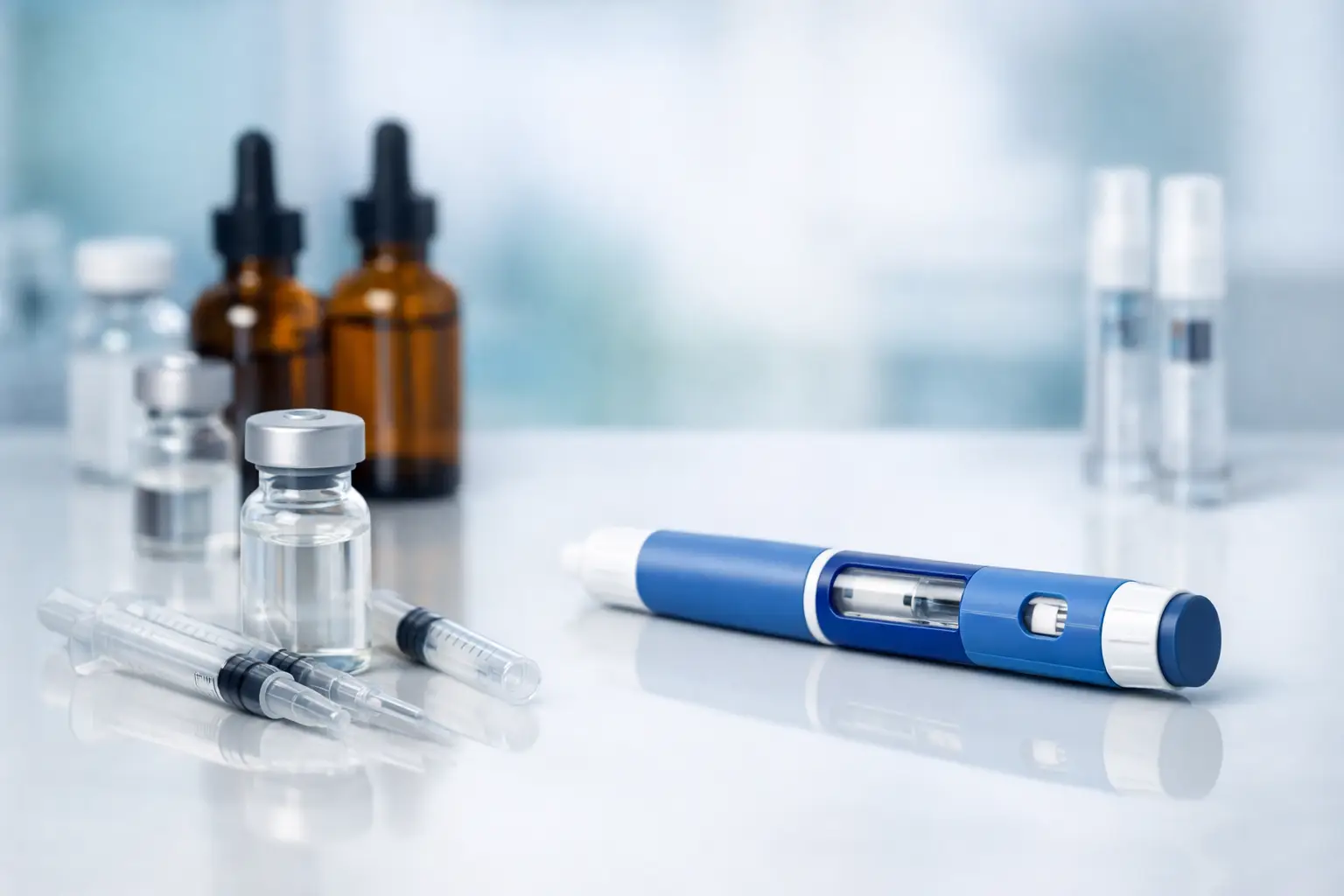


SVT is a peptide-related wellness product whose evidence, formulation, and regulatory status should be confirmed before use; the abbreviation alone does not establish a specific medication or FDA-approved indication. Because human data may be limited or unavailable for a marketed SVT product, eligibility, ingredients, sourcing, dosing, and monitoring should be reviewed by a qualified clinician rather than inferred from promotional claims.
Ready to find out if you qualify? Start Free Assessment — No payment required
What Is SVT?
The term "SVT" may refer to a branded or clinic-described peptide product, but it is not, by itself, a universally recognized FDA-approved active ingredient or standardized prescription name. A responsible review should identify the exact compound or compounds, concentration, route of administration, intended use, pharmacy source, and labeling.
That distinction matters. A product page or social-media post may use a short name without providing enough information to evaluate its pharmacology. Before considering SVT, ask for the active ingredient, the medication label, the prescribing clinician, and whether the product is FDA-approved for the proposed use.
If SVT is compounded, it is important to distinguish it from FDA-approved products. Compounded medications are prepared by an appropriately permitted pharmacy for individual patient needs and are not FDA-approved in the same way as commercially manufactured drugs. A compounded product should not be described as the same as, generic to, or equivalent to an FDA-approved brand-name medication.
What Does the Evidence Show?
Evidence must be matched to the exact ingredient, dose, formulation, route, and medical indication. Research on a related peptide does not automatically validate a product called SVT. Laboratory findings, animal studies, testimonials, and unpublished material can help generate questions, but they do not establish clinical effectiveness or safety in people.
For many wellness peptides, high-quality human evidence may be limited. That can mean few or no peer-reviewed randomized trials for the exact product, uncertain long-term outcomes, incomplete information about interactions, or no FDA-approved labeling for the marketed use. If a provider cannot identify reliable human evidence for the exact formulation, the appropriate conclusion is uncertainty—not a promise of benefit.
A useful evidence hierarchy is:
| Evidence source | What it can tell you | What it cannot prove | |---|---|---| | FDA-approved prescribing information | Approved indications, dosing, contraindications, warnings, and known adverse reactions for that specific product | That an unrelated peptide or compounded formulation has the same profile | | Peer-reviewed human clinical trials | Effects and risks under studied conditions | Results for a different dose, formulation, population, or duration | | Systematic reviews and NIH-indexed research | How findings fit across studies | That limited evidence becomes conclusive | | Animal or laboratory research | Biological plausibility and early safety signals | Clinical effectiveness or long-term human safety | | Testimonials and marketing claims | Individual experiences or commercial messaging | Reliable efficacy, comparative benefit, or population-level safety |
For an evidence-focused discussion of weight-loss medications, see Is semaglutide safe? and semaglutide vs. tirzepatide. Those FDA-approved medicines have their own evidence and labeling; that evidence should not be transferred automatically to SVT.
Potential Mechanism and Important Uncertainty
A mechanism describes how a compound might act in the body, such as influencing appetite signaling, glucose regulation, gastric emptying, or another physiological pathway. A proposed mechanism can explain why researchers are interested in a peptide, but it does not demonstrate that a specific product produces meaningful or durable weight loss.
For SVT, the mechanism should be confirmed from authoritative product documentation or peer-reviewed research about the exact active ingredient. If the formulation is undisclosed, uses a combination, or is marketed under a nonstandard name, mechanism-based claims are especially difficult to verify. Avoid assuming that a peptide is safe because it is naturally occurring, injectable, or described as research-backed.
The clinical questions remain more important than a mechanism alone: Was the exact product studied in people? Were participants similar to you? What outcomes were measured? How long were they followed? What adverse events occurred? Was the product manufactured and tested consistently?
Safety: What Should Be Reviewed?
Safety depends on the ingredient, dose, administration method, medical history, other medications, and product quality. Potential risks may include injection-site reactions, gastrointestinal symptoms, allergic reactions, medication interactions, dosing errors, contamination, or effects on existing medical conditions. The relevant risks cannot be listed responsibly without knowing what SVT contains.
A provider should review pregnancy or plans for pregnancy, breastfeeding, allergies, history of pancreatitis or gallbladder disease when relevant to the ingredient, diabetes treatment, kidney or liver disease, eating-disorder history, cardiovascular conditions, and current prescription or nonprescription products. The clinician should also explain warning symptoms and when urgent care is appropriate.
If a product is compounded, ask how the pharmacy is licensed, how the product is labeled, how storage and shipping are handled, and what to do if the vial, packaging, or instructions appear abnormal. FDA has warned about risks associated with compounded drugs and unauthorized versions of approved medications, including quality, dosing, and shipping concerns. A compound is not automatically unsafe, but its oversight and evidence profile differ from those of an FDA-approved product.
Never change a dose, combine peptides, or use a product obtained from an unverified online source without clinician guidance. Results vary, and a lack of early side effects does not prove long-term safety.
Provider-Review Checklist
Before starting any SVT-related program, confirm that the service can answer these questions:
- What is the exact active ingredient and concentration?
- Is the product FDA-approved for this use, or is it compounded or investigational?
- Who evaluates eligibility and contraindications?
- What evidence applies to this exact formulation and dose?
- Which side effects require contacting the provider or seeking emergency care?
- How are follow-up visits, dose changes, and laboratory tests handled?
- How are prescriptions dispensed, shipped, stored, and replaced if damaged?
- What happens if the treatment is ineffective or not tolerated?
- What are the total costs, including consultation, medication, shipping, and follow-up?
EdenRx provides information about online weight-loss care, but an online program should still involve individualized medical review. Telehealth is not a substitute for emergency care, and some symptoms or medical histories require in-person evaluation.
Why Provider Review Matters
Provider review helps separate a patient’s health needs from a product’s marketing language. A licensed clinician can determine whether the requested treatment is appropriate, identify conditions that may change the risk assessment, review other medications, and explain alternatives with stronger evidence when applicable.
Review is particularly important when the product name is ambiguous or when the evidence is indirect. A responsible provider should be transparent about what is known, what is uncertain, and why a medication may or may not be offered. Eligibility is not guaranteed, and a clinician may recommend a different treatment, additional evaluation, or no medication.
For patients in Florida and New York, confirm that the clinician is authorized to provide care where you are located at the time of the visit. The prescribing decision remains individualized, and state rules, pharmacy availability, and clinical circumstances can affect options.
Built from Eden Med Spa — real patients, real treatments.
Cost, Access, and Program Questions
Cost should be evaluated alongside clinical oversight. Ask whether pricing includes the medical assessment, prescription review, medication, supplies, shipping, follow-up, and management of side effects. The pricing page can help explain program costs, while programs may show available care pathways.
A lower advertised price may not include the services needed for safe treatment. Conversely, a higher price does not prove better effectiveness. Compare services, transparency, follow-up, and product documentation rather than relying on price alone.
Want a clinician-guided next step? Start Free Assessment — No payment required
Evidence and Sources
The FDA is the authoritative source for approval status, safety communications, and information about compounded drugs. FDA materials explain that compounded drugs are not FDA-approved and that the agency does not verify their safety, effectiveness, or quality before marketing in the same way it evaluates approved medicines. Review current FDA information at fda.gov.
The National Library of Medicine’s PubMed database can be used to locate peer-reviewed human research for a named active ingredient, formulation, and indication at pubmed.ncbi.nlm.nih.gov. Search results should be checked against the actual study methods and population rather than cited as proof by title alone.
For FDA-approved medicines, the official prescribing information provides the most relevant approved dosing, contraindications, warnings, and adverse-reaction information. It is not appropriate to apply that labeling to an unrelated or compounded product without evidence supporting the comparison.
Because the public term SVT may not identify one standardized ingredient, this article does not assign it a mechanism, effectiveness rate, or safety profile that cannot be verified. Product-specific claims should be confirmed with the prescribing clinician and current documentation.
Frequently Asked Questions
Is SVT FDA-approved?
The abbreviation SVT alone does not establish FDA approval. Ask for the exact active ingredient and product name, then verify whether that specific product is FDA-approved for the proposed use. If it is compounded, it should not be presented as FDA-approved or equivalent to an approved brand-name medicine.
Does SVT work for weight loss?
That depends on the exact formulation and the quality of human evidence. Testimonials or research on a different peptide do not prove that SVT causes weight loss. A provider should explain what evidence applies and what outcomes remain uncertain.
Is compounded SVT safe?
Safety cannot be determined from the word "compounded" alone. Risk depends on the ingredients, dose, pharmacy processes, storage, patient history, and monitoring. Compounded medications are not FDA-approved in the same manner as commercial products, so patients should receive clear counseling about uncertainty and potential risks.
Who may not be eligible?
Eligibility varies with the ingredient and a person’s health history. Pregnancy, breastfeeding, allergies, interacting medications, certain gastrointestinal or endocrine conditions, and other medical concerns may affect eligibility. A licensed provider must make the individualized decision.
Can I use SVT with semaglutide or tirzepatide?
Do not combine peptide products or prescription weight-loss medicines unless a qualified clinician specifically directs you to do so. Combining treatments may increase adverse effects or create unknown risks, especially when the ingredients or doses are unclear.
How can I evaluate an online SVT provider?
Look for licensed clinician review, transparent ingredient and pharmacy information, clear discussion of evidence and uncertainty, follow-up care, emergency guidance, and straightforward pricing. Be cautious of guaranteed results, undisclosed ingredients, pressure to purchase, or claims that a compounded product is the same as an FDA-approved drug.
Conclusion
SVT should be evaluated as a specific product—not as a reassuring label or a substitute for evidence. Confirm the ingredient, regulatory status, research quality, safety considerations, pharmacy details, and provider oversight before making a decision. If you are located in Florida or New York, start a free assessment to learn whether a clinician-guided program may be appropriate; you may be eligible for an option, but results vary and no treatment is guaranteed.