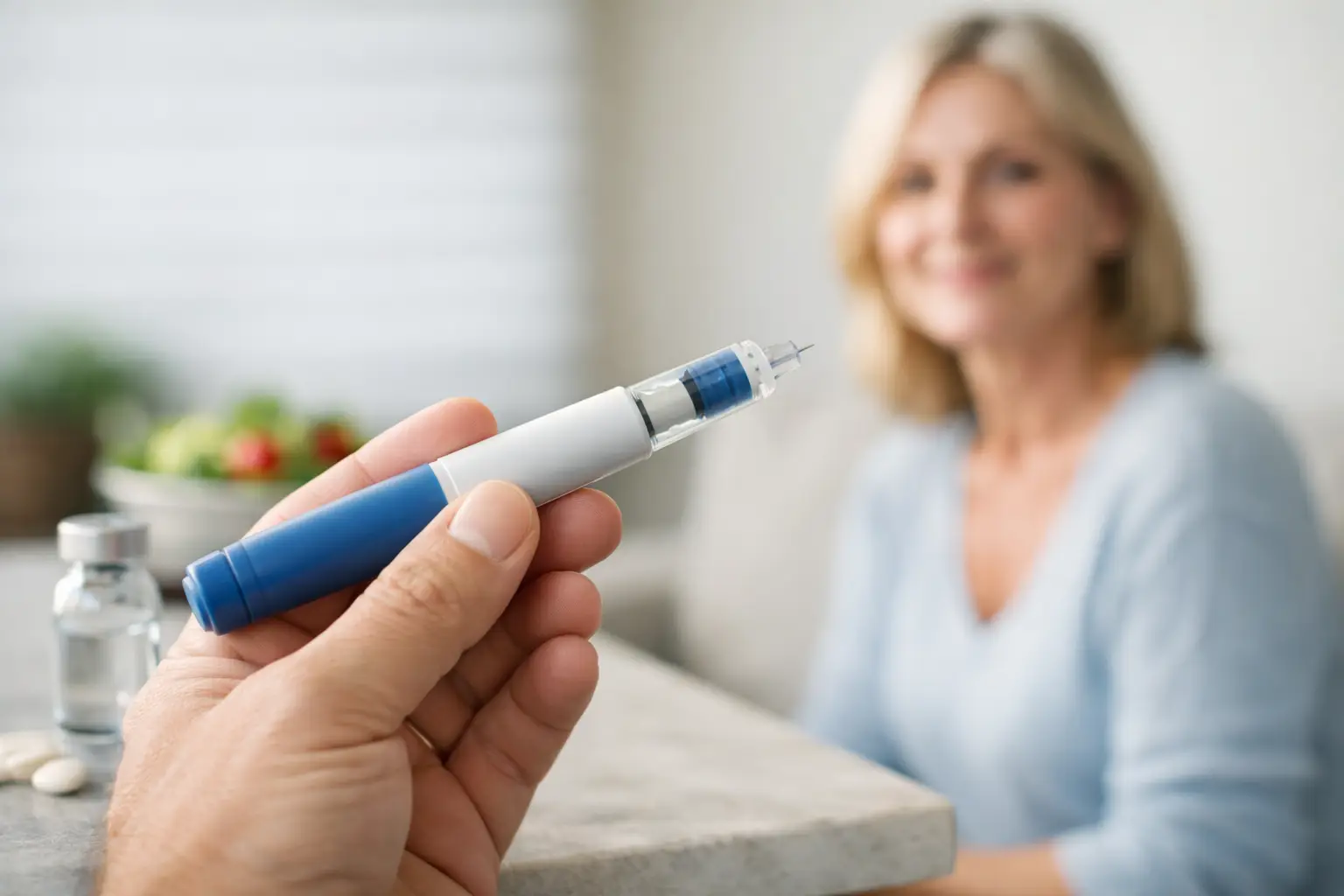


Melanotan 2 acetate is a synthetic melanocortin receptor agonist sold online for tanning and other off-label uses; clinical evidence in humans is limited and safety questions remain, so any use should be considered experimental and reviewed by a licensed clinician in Florida or New York.
Ready to find out if you qualify? Start Free Assessment — No payment required
What is Melanotan 2 acetate and how is it proposed to work?
Melanotan 2 (MT-II) is a synthetic analog of alpha-melanocyte–stimulating hormone (α-MSH). It is thought to activate melanocortin receptors (primarily MC1R and MC4R) which in preclinical models influence melanogenesis (pigment production), appetite, and sexual function. Most products marketed as "Melanotan 2 acetate" are compounded peptides sold online; these are not FDA-approved medications for tanning, weight loss, or sexual dysfunction. For the canonical product/program information, see /peptides/melanotan-2-acetate.
Regulatory and legal context (why this matters)
- The U.S. Food & Drug Administration has not approved Melanotan II for any indication and has issued consumer safety communications about unapproved injectable products marketed as Melanotan. These products may be misbranded, contaminated, or of inconsistent potency.
- Compounded peptides are prepared by compounding pharmacies under state pharmacy rules; they are distinct from FDA-approved medications and are subject to different oversight. Compounded products are not equivalent to FDA-approved brand-name drugs.
- Because marketing often crosses state lines, legal and supply-chain risks exist; patients in Florida and New York should consult licensed providers to understand local regulations and access pathways.
What the evidence actually shows
The research landscape for Melanotan 2 acetate is heterogeneous and limited:
- Types of evidence: animal studies, small human experimental studies, and case reports predominate. These sources may suggest biological effects on pigmentation and neuroendocrine pathways, but they are not sufficient to establish routine clinical safety or effectiveness for marketed wellness uses.
- Lack of large randomized controlled trials: There are no large, high-quality randomized controlled trials establishing long-term safety or clear efficacy for tanning, weight loss, or sexual function in diverse populations.
- Known clinical observations: Published case reports and small studies have documented adverse events such as nausea, flushing, vomiting, changes in blood pressure, hyperpigmentation, and reports raising concerns about potential effects on melanocytic lesions.
See the Evidence section below for authoritative sources.
Safety profile and main uncertainties
Melanotan 2 acetate use carries known and theoretical risks:
- Short-term reactions: nausea, facial flushing, increased blood pressure, and injection-site reactions have been reported.
- Pigment changes: diffuse or localized hyperpigmentation can occur; new or changing moles should be evaluated by a dermatologist.
- Potential oncologic concerns: because MT-II affects melanocyte pathways, there is scientific debate about whether exogenous melanocortin agonists could influence melanoma risk; evidence is inconclusive. This uncertainty is a major reason clinicians caution against unsupervised use.
- Product quality risks: unregulated online products may contain contaminants, variable peptide purity, or inaccurate labeling. These supply-chain problems are separate from the molecule's pharmacology and can introduce additional safety hazards.
- Drug interactions and contraindications: because MT-II may affect blood pressure, appetite, and hormonal pathways, it could interact with cardiovascular drugs or other peptides/medications. Pregnant or breastfeeding people, and individuals with active skin cancers or uncontrolled cardiovascular disease, would typically be ineligible pending provider review.
Checklist: Safety considerations to discuss with a provider
- Current medications and supplements (including prescription, OTC, and herbal)
- Past or family history of melanoma or atypical moles
- Cardiovascular history (hypertension, arrhythmia, ischemic disease)
- Pregnancy or breastfeeding plans
- Allergies and past injection reactions
- Source of peptide and documentation of compounding pharmacy (if applicable)
What a provider review at EdenRx looks for
A provider review is an individualized clinical assessment designed to evaluate potential benefits, harms, and eligibility. At EdenRx, the review includes:
- Medical history and medication reconciliation to identify contraindications.
- Focused dermatologic and oncologic screening questions about moles, sun exposure, and prior skin biopsies.
- Assessment of cardiovascular and endocrine risk factors that could increase adverse event risk.
- Discussion of evidence limitations, alternative options, and monitoring plans if use is considered.
- If eligible and appropriate, providers will recommend safe sourcing, dosing and monitoring steps, and schedule follow-up.
Why this process matters: the same molecule obtained from different vendors can have very different risk profiles. A licensed clinician helps distinguish experimental use from evidence-based treatment and documents informed consent.
Comparison table: Evidence types and what they mean for patients
| Evidence type | What it tells us | How to interpret | |---|---:|---| | Animal studies | Mechanism insights (receptor binding, pigmentation pathways) | Useful for biology but not proof of human safety or effectiveness | | Small human trials / experimental studies | Short-term physiological effects; limited sample sizes | Suggestive but not definitive; often lack long-term safety data | | Case reports / series | Signal detection for rare or serious adverse events | Important for safety vigilance but cannot establish frequency | | Regulatory statements (FDA) | Legal and public health stance on marketed products | Indicates lack of FDA approval and consumer risk |
For the canonical program and eligibility, see /peptides/melanotan-2-acetate and consider related treatment contexts in our programs.
Provider decisions: eligibility, monitoring, and follow-up
If a licensed EdenRx provider determines a patient is potentially eligible, typical elements of a safe plan include:
- Baseline screening: dermatologic exam (in-person or via tele-dermatology referral), vitals, and focused labs when indicated.
- Education on injection technique and safe storage.
- Clear plan for monitoring and reporting adverse events (timelines and emergency instructions).
- Documentation that compounded products are not FDA-approved and discussion of supply risks.
Related resources: patients curious about other prescription-mediated weight-loss options can compare approaches at /is-semaglutide-safe and /semaglutide-vs-tirzepatide, or explore telehealth weight-loss access at /weight-loss-online.
Why Provider Review Matters A rigorous provider review reduces risk by evaluating individualized contraindications, clarifying evidence limitations, and ensuring monitoring. Because Melanotan 2 acetate products are not FDA-approved and may be compounded, a clinician must also evaluate product source and counsel on legal and safety implications specific to Florida and New York. Provider review is not an endorsement of unproven uses; it is a safety checkpoint.
Evidence (authoritative sources)
The following types of sources form the foundation for the statements above; readers should consult these public resources for original documents and updates:
- U.S. Food & Drug Administration (FDA): The FDA has issued public communications and warnings concerning unapproved products marketed as "Melanotan" or "Melanotan II," noting the absence of FDA approval and risks associated with unregulated injectable products. See FDA.gov for consumer alerts and enforcement actions.
- PubMed / National Library of Medicine (NIH): The PubMed database (pubmed.ncbi.nlm.nih.gov) contains animal studies, small human experimental studies, case reports, and reviews that explore melanocortin analogs, their pharmacology, and observed adverse events. Examples include case reports documenting systemic side effects and dermatologic changes.
- Peer-reviewed dermatology and pharmacology journals: Published case reports and small studies in peer-reviewed journals have documented adverse events (nausea, hyperpigmentation, injection-site reactions) and raised questions about long-term melanocyte effects. Readers may search PubMed for terms like "Melanotan" or "melanocortin agonist" to locate primary literature.
Note: Because the evidence base is limited and evolving, clinicians rely on these authoritative sources plus clinical judgment. We do not make clinical claims beyond what these sources support.
Built from Eden Med Spa — real patients, real treatments.
Ready to find out if you qualify? Start Free Assessment — No payment required
Frequently Asked Questions
Q: Is Melanotan 2 acetate FDA-approved? A: No. Melanotan 2 acetate is not approved by the U.S. Food and Drug Administration for tanning, weight loss, sexual dysfunction, or other wellness indications.
Q: Can using Melanotan 2 prevent sunburn or skin cancer? A: No guaranteed protective effect should be assumed. The relationship between melanocortin agonists and skin cancer risk is not established; sunscreen and sun-protection behaviors remain the evidence-based approach to reduce skin cancer risk.
Q: How do EdenRx providers decide who may be eligible? A: Eligibility is determined through medical history, medication review, dermatologic risk assessment, and discussion of evidence limitations. Eligibility is assessed on a case-by-case basis in Florida and New York.
Q: Are compounded Melanotan 2 products the same as FDA-approved drugs? A: No. Compounded peptides are not the same as FDA-approved medications, and they do not carry the same evidence or regulatory oversight as approved drugs.
Q: What monitoring is recommended if someone uses Melanotan 2? A: Monitoring typically includes skin exams, reporting of systemic symptoms (nausea, cardiovascular symptoms), and follow-up with the prescribing provider. Any new or changing pigmented skin lesions should prompt immediate dermatologic evaluation.
Q: Are there safer, evidence-based options for tanning or for the issues people sometimes seek Melanotan for? A: For tanning appearance, topical bronzers and sunless tanning products are evidence-based ways to change skin color without UV exposure. For weight loss or sexual dysfunction, there are FDA-approved treatments with clinical data; discuss alternatives with a provider and consider resources like /programs and /pricing to learn about structured, evidence-based options.
Conclusion
Melanotan 2 acetate is an unapproved synthetic melanocortin analog with limited human evidence and important safety and regulatory concerns. Because product quality varies and long-term risks are uncertain, clinical use should only occur after informed, documented provider review. If you live in Florida or New York and want to explore whether you may be an appropriate candidate for supervised care or alternative evidence-based options, begin with a clinical assessment.
Ready to learn if you qualify? Start Free Assessment — No payment required. For more on the canonical program and product details, visit /peptides/melanotan-2-acetate. If you’re comparing treatment pathways, see our related pages /weight-loss-online, /is-semaglutide-safe, and /semaglutide-vs-tirzepatide for context about other prescription options and enrollment details at /programs and /pricing.