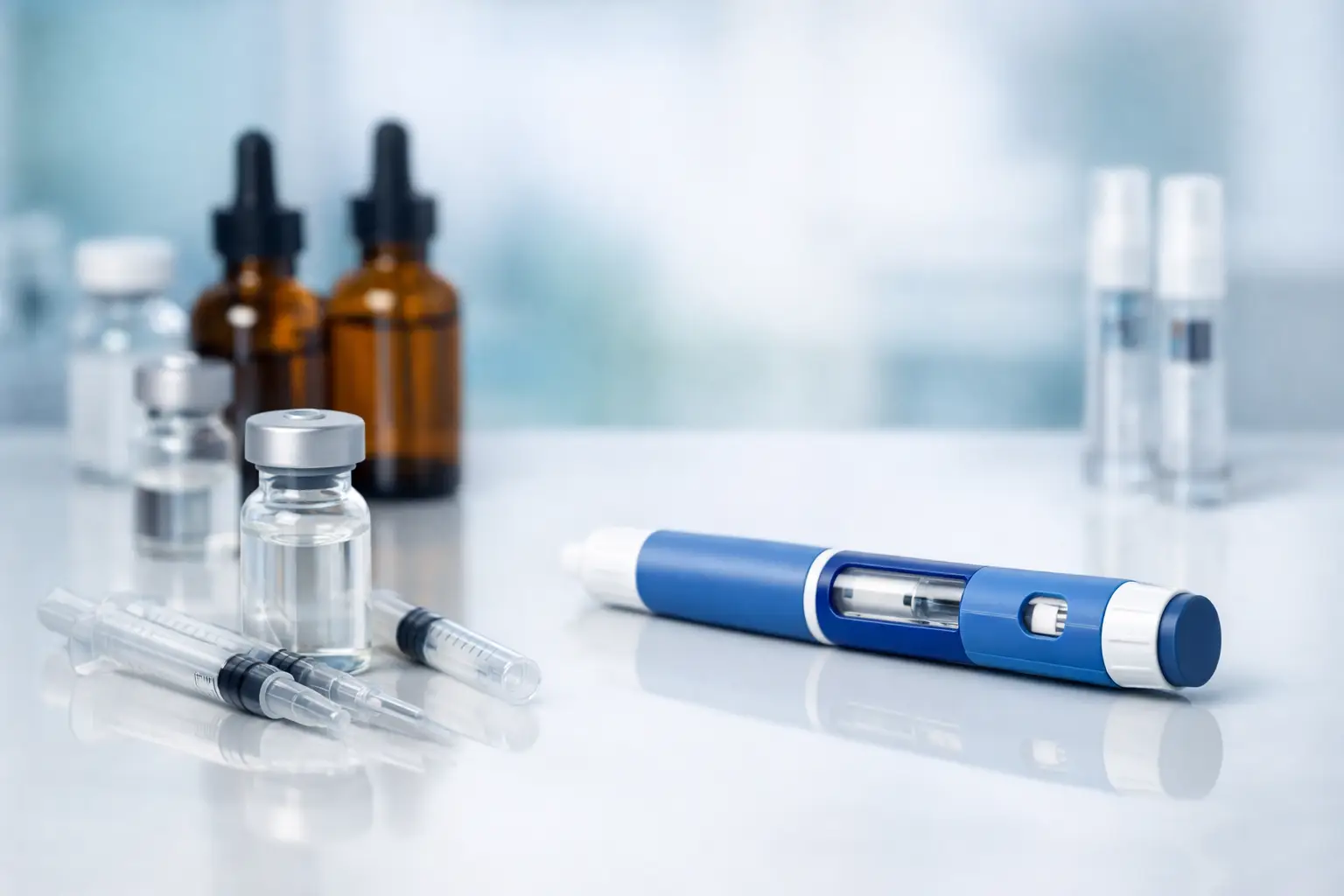


Direct answer: Ipamorelin is a growth-hormone secretagogue peptide used in research and some compounding clinics; evidence in humans is limited and mixed, and it is not an FDA‑approved therapy for weight loss, anti-aging, or athletic enhancement. If eligible, patients may potentially see changes in growth-hormone axis markers, but there are no guarantees for sleep, recovery, or body-composition outcomes.
Ready to find out if you qualify? Start Free Assessment — No payment required
What ipamorelin is and how it is proposed to work
Ipamorelin is a synthetic peptide that stimulates the release of growth hormone (GH) by acting as a growth hormone secretagogue at pituitary receptors. It is often described alongside other ghrelin mimetics and secretagogues that transiently increase circulating GH and insulin-like growth factor 1 (IGF-1) in some people. Proposed downstream effects include altered metabolism, changes in lean mass, and potential impacts on sleep and recovery, but those effects are inconsistent in human studies.
Important regulatory note: ipamorelin formulations used in clinical practice are typically compounded products. Compounded peptides are not the same as FDA‑approved drugs, and they do not carry the same approvals or labeling. Learn more about the clinical program and product details at /peptides/ipamorelin and consider an assessment at /assessment.
Evidence overview: what the science actually shows
The quality of evidence for ipamorelin varies. Most published work consists of preclinical studies, small human pharmacology/physiology trials, and comparisons with other secretagogues. Large randomized, placebo‑controlled trials demonstrating consistent clinical benefits in target outcomes like weight loss, muscle mass increases, or improved sleep are limited or absent.
Table: Typical evidence tiers for ipamorelin-related claims
| Claim area | Typical evidence base | Confidence for clinical effect | |-----------|----------------------:|-------------------------------:| | Acute GH stimulation (pharmacodynamics) | Small human and many animal studies; peer-reviewed pharmacology literature | Moderate for transient GH rise in some protocols | | Long-term body composition or weight loss | Sparse; small uncontrolled or short-term studies | Low — insufficient high‑quality RCT data | | Safety and hormone-axis effects | Limited human safety datasets; more data from GH therapies in general | Low-to-moderate; watch for theoretical risks |
Selected authoritative resources: PubMed/NIH (peer-reviewed articles on growth hormone secretagogues), official guidance and statements by regulators on compounded drugs (FDA), and clinical practice guidelines for growth-hormone therapies (Endocrine Society). These are the primary places to verify published human trials and safety data.
Safety considerations and hormone-axis uncertainty
Because ipamorelin acts on the GH axis, its safety profile requires attention to potential endocrine effects. Key points providers monitor include:
- Downstream hormone changes: GH increases can raise IGF-1; chronically elevated IGF-1 levels have theoretical risks and require monitoring. Clinical guidelines for GH therapy (e.g., from endocrine societies) inform monitoring practices even if ipamorelin is used off-label or as a compounded peptide.
- Metabolic effects: GH affects glucose metabolism and insulin sensitivity; patients with diabetes or prediabetes need careful assessment. For broader comparisons of weight-loss drugs and metabolic safety see /is-semaglutide-safe and /semaglutide-vs-tirzepatide.
- Injection-site and compounding risks: Compounded injectables carry risks related to sterility, potency variability, and labeling that differ from manufactured FDA‑approved drugs.
- Unknown long-term outcomes: Longitudinal safety data are limited; many peptides lack multi-year safety surveillance in community use.
Providers generally perform baseline labs (GH/IGF-1 where relevant, metabolic panel, HbA1c in at‑risk patients) and repeat monitoring if therapy is started. This is part of the provider review described below.
Who might be assessed and how providers evaluate candidates
Providers who prescribe peptides like ipamorelin evaluate clinical goals, medical history, and baseline labs. Common elements of a provider review include:
Checklist for initial assessment
- Medical history review: diabetes, cancer history, pituitary disorders, pregnancy, active malignancy
- Medication review: drugs that interact with glucose or hormone axes
- Baseline labs: metabolic panel, HbA1c (if indicated), IGF‑1 when monitoring GH-axis effects
- Risk discussion: compound status, limited evidence, expected monitoring schedule
- Cost and logistics: outpatient injections, lab follow-up, and program pricing (/pricing) or membership details (/programs)
Eligibility is individualized: some patients are excluded because of active cancer, uncontrolled diabetes, or pituitary disease. In Florida and New York, clinicians follow state scope-of-practice and prescribing standards; at EdenRx, clinicians review eligibility via /assessment before any program enrollment.
Practical access, cost, and program fit
Ipamorelin is commonly available through compounding pharmacies and clinician-supervised peptide programs rather than as an FDA‑approved brand product. That affects cost, insurance coverage (usually not covered), and quality oversight.
- Cost: Programs vary; expect out‑of‑pocket expenses that often include initial consults, labs, medication compounding, and follow-up. See /pricing for example program structures. If you’re simultaneously considering GLP‑1 receptor agonists for weight management, our /weight-loss-online program may address alternative evidence-based options.
- Program fit: Many practices pair peptide protocols with lifestyle coaching and medical monitoring. Discuss realistic goals with your clinician; ipamorelin should not be treated as a standalone guaranteed solution.
Provider review: what clinicians look for and why it protects patients
Why Provider Review Matters
A clinician’s review is essential because ipamorelin use involves endocrine modulation, individualized risk, and compounding considerations. A provider assesses whether the peptide is appropriate for a patient’s medical profile, orders appropriate baseline and follow‑up labs, sets realistic expectations, and documents informed consent about off‑label/compounded status. Providers also monitor for adverse effects and coordinate care with endocrinology when necessary.
Provider review also ensures: verification of compounding source quality, documentation of shared decision-making, and alignment with regional laws in Florida and New York. If you want a clinician assessment, begin with our free screening at /assessment.
Evidence details and authoritative references
The following summarizes the kinds of evidence you’ll find and where to verify study details:
- Pharmacology and short human pharmacodynamic studies: Peer-reviewed journals indexed in PubMed describe ipamorelin and other secretagogues’ ability to transiently stimulate GH release. For details, search PubMed (NIH/NLM) for "ipamorelin" and "growth hormone secretagogue." PubMed is the primary database for locating original trials and reviews.
- Regulatory context for compounded peptides: The U.S. Food and Drug Administration (FDA) provides guidance on compounding, the difference between approved and compounded products, and risks associated with non‑approved therapies. See FDA resources regarding compounding and patient safety.
- Clinical practice context for GH-axis interventions: Endocrine society clinical practice guidelines for growth-hormone therapy inform monitoring and safety practices in patients receiving agents that affect GH/IGF-1, and are useful to understand potential risks even when the agent is compounded.
These authoritative sources are where providers and patients should verify trial designs, endpoints, and safety signals. Because many individual peptides do not have large phase 3 trial programs for wellness indications, clinical decisions rely on smaller studies, mechanistic data, and general endocrine safety principles.
Built from Eden Med Spa — real patients, real treatments.
Ready to find out if you qualify? Start Free Assessment — No payment required
Frequently Asked Questions
Q: Is ipamorelin FDA‑approved? A: No. Ipamorelin is not FDA‑approved for weight loss, anti-aging, or general wellness. Many clinical offerings use compounded ipamorelin, which is not equivalent to an FDA‑approved product.
Q: Does ipamorelin guarantee improved sleep, recovery, or body composition? A: No. Some people report subjective improvements, but the evidence is inconsistent. There are no guarantees; results vary and may be influenced by many factors, including lifestyle and baseline health.
Q: How do providers check safety before prescribing? A: Providers take a medical history, check for contraindications (e.g., active cancer, uncontrolled metabolic disease), order baseline labs (metabolic panel, HbA1c, IGF‑1 when relevant), and schedule follow-up monitoring.
Q: How is ipamorelin administered? A: In clinical programs it is typically given by subcutaneous injection. Dosing regimens are individualized by a clinician; discuss administration and training during your assessment.
Q: Will insurance pay for ipamorelin? A: Most compounding peptide therapies for wellness are not covered by insurance. Verify coverage and expected out-of-pocket costs; see /pricing for program cost structures.
Q: How does ipamorelin compare to GLP‑1 medications like semaglutide? A: They act through different mechanisms—GLP‑1 receptor agonists are well-studied for weight management and have FDA approvals for certain indications. Ipamorelin targets GH release and has different evidence and safety considerations. For comparisons and alternatives, see /is-semaglutide-safe and /semaglutide-vs-tirzepatide.
Conclusion
Ipamorelin is a growth-hormone secretagogue with physiologic activity in many studies, but clinical evidence for meaningful, durable changes in sleep, recovery, or body composition is limited. Safety considerations focus on effects to the GH/IGF‑1 axis, metabolic monitoring, and compounding-related quality issues. A thorough provider review—covering medical history, labs, and realistic expectations—is essential before starting any peptide program. If you’re in Florida or New York and considering peptide therapy, begin with a clinician assessment to determine if you may be eligible.
Ready to take the next step? Start Free Assessment — No payment required. Explore program options and pricing at /programs and /pricing, or learn more about the specific peptide product at /peptides/ipamorelin.