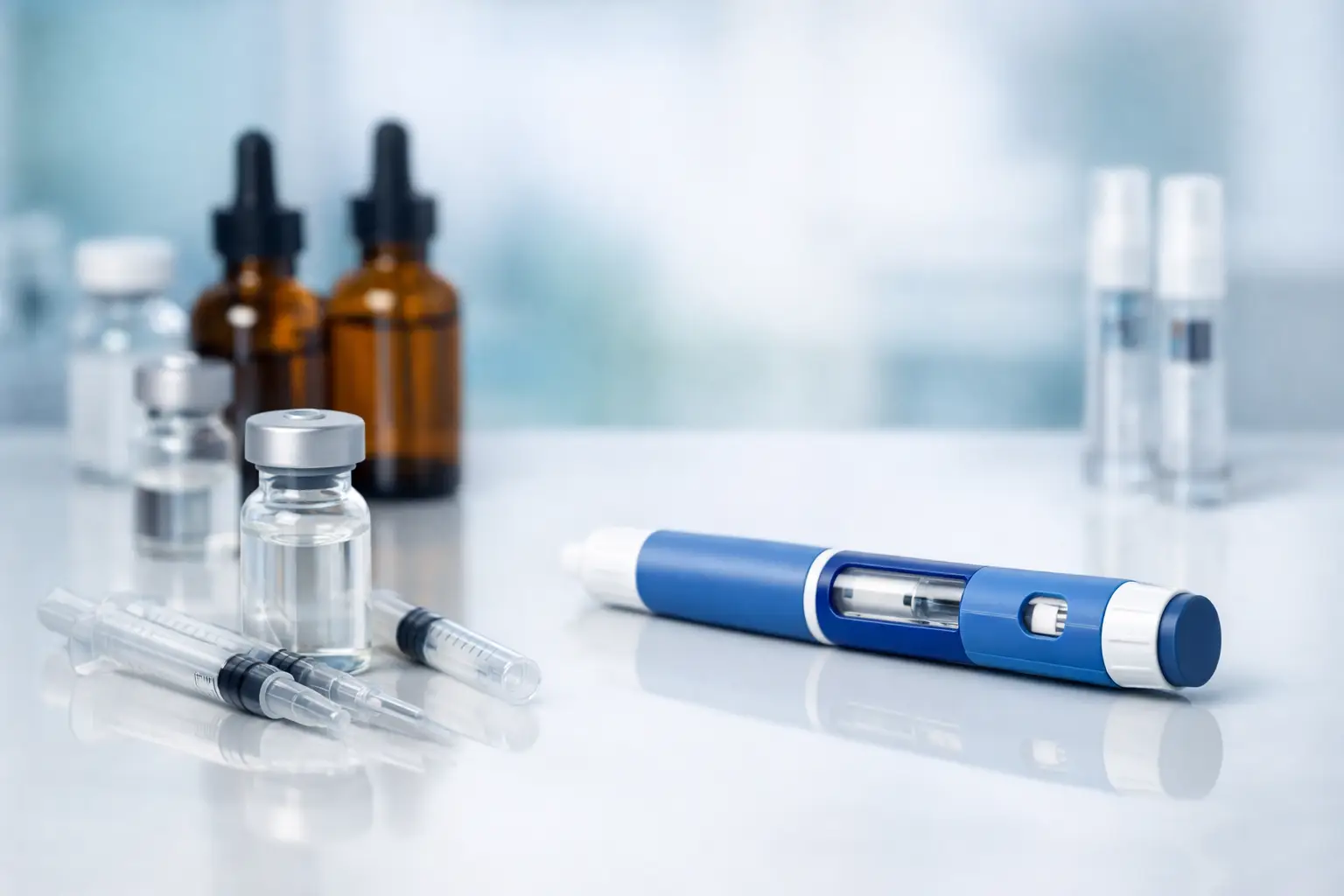


An Epithalon prescription label should be checked against the prescription and pharmacy instructions before use, especially when the product is compounded or the evidence is limited. If any detail is missing, inconsistent, or unclear, pause and contact the dispensing pharmacy or prescribing provider rather than guessing.
Ready to find out if you qualify? Start Free Assessment — No payment required
What Epithalon is—and why the label deserves careful review
Epithalon, also called epitalon in some scientific literature, is a synthetic peptide discussed in connection with laboratory research on cellular aging, telomere biology, melatonin-related pathways, and other proposed mechanisms. These proposed mechanisms are not proof that Epithalon prevents aging, treats disease, extends life, or produces a specific wellness outcome in people.
Epithalon is not an FDA-approved medication for marketed anti-aging or general wellness uses. Human evidence is limited, and product quality, formulation, and clinical oversight can vary. A prescription label therefore should not be treated as evidence that a product is FDA-approved or that a particular use is established. For broader background, visit EdenRx's Epithalon information page, which serves as the product and program hub.
A label is primarily a medication-identification and handling document. It should help you determine what the pharmacy dispensed, who prescribed it, how it is intended to be handled, and how to obtain clarification. It should not replace individualized instructions from a licensed clinician.
How to read an Epithalon prescription label
Review the label before opening the package. Keep the container, pharmacy paperwork, and prescription instructions together. The following fields are especially important:
| Label field | What to verify | Why it matters | |---|---|---| | Patient name | Your full name or identifying details match | Prevents mix-ups between patients or households | | Medication name | The name and spelling match the prescription | Different names or formulations may not be interchangeable | | Strength or concentration | Units and concentration are clearly printed | A concentration describes the product; it is not automatically a personal dose instruction | | Dosage form and route | For example, a specified injectable or non-injectable form, if applicable | Route affects administration, storage, and safety questions | | Directions | Written directions are complete and legible | Never infer missing instructions from another product or online post | | Quantity and beyond-use date | The amount supplied and the date are present | Compounded preparations may have a pharmacy-assigned beyond-use date | | Storage instructions | Temperature, light, and handling requirements are stated | Improper storage may affect product quality | | Pharmacy details | Name, address, phone number, and license information where provided | Gives you a direct source for product and dispensing questions | | Prescriber details | Prescriber name and contact route are available | Supports questions about intended use and clinical eligibility | | Lot or batch information | Record it if listed | Useful if the pharmacy needs to investigate a concern |
Pay close attention to units. Words such as milligrams, micrograms, milliliters, units, and concentration are not interchangeable. A vial's total amount, concentration, and the quantity used at one time are different concepts. This article intentionally does not convert those values into dosing instructions because the correct interpretation depends on the exact formulation, route, prescription, and provider direction.
Label verification checklist before use
Use this checklist to identify questions, not to self-prescribe:
- [ ] The patient name matches your prescription.
- [ ] The medication name and formulation match the paperwork.
- [ ] The strength or concentration is readable.
- [ ] Directions include the route and any required timing or handling details.
- [ ] The quantity and beyond-use date are present.
- [ ] Storage and discard instructions are clear.
- [ ] The container is intact and the contents do not appear unexpectedly damaged, leaking, or contaminated.
- [ ] The pharmacy phone number is available.
- [ ] You know how to reach the prescribing provider for clinical questions.
- [ ] You have not changed, combined, or substituted products based on internet advice.
If a label fails any of these checks, do not improvise. Ask the pharmacy whether the label matches the prescription and ask the provider to clarify the intended plan when the question involves your health, eligibility, route, or use.
Compounded Epithalon and FDA approval: what the label does not prove
A compounded preparation is made by a pharmacy or outsourcing facility under applicable federal and state requirements. A compounded product is not the same as an FDA-approved drug, a generic version of an FDA-approved drug, or an FDA-approved equivalent. Compounded products do not undergo FDA premarket review for safety, effectiveness, or manufacturing quality in the same way approved drugs do.
The presence of a prescription label does not mean that FDA has approved the compounded product or its use. The label also cannot establish that the preparation is clinically effective for anti-aging, sleep, immune, metabolic, or other wellness claims. Ask the pharmacy whether the product is compounded, where it was prepared, how it should be stored, and what documentation is available about ingredients and quality controls.
FDA has warned that unapproved products and compounded drugs can present risks involving contamination, incorrect strength, labeling, sterility, and adverse reactions. These concerns are especially important for products intended for injection or other routes that require strict handling. Check current FDA safety communications and ask a licensed professional about any product-specific concern.
For people considering medically supervised weight management, Epithalon should not be confused with FDA-approved weight-management medicines. EdenRx provides separate educational resources about weight-loss care online, semaglutide safety, and semaglutide versus tirzepatide. Those medications have different evidence, indications, labeling, and safety considerations.
Evidence, proposed mechanisms, and uncertainty
Laboratory and early clinical literature has explored theories involving Epithalon and biological aging pathways. However, mechanistic findings or small, older, limited, or non-confirmatory human reports do not establish a reliable clinical benefit. There is not enough high-quality evidence to conclude that Epithalon treats or prevents a disease, reverses aging, extends lifespan, or provides a predictable outcome for an individual.
Evidence quality matters when reading online claims. Ask whether a source is a peer-reviewed human study, a laboratory experiment, a review, a promotional page, or an anecdote. Also ask whether the studied product, route, dose, purity, and population actually match the product on your label. If those details differ, the study may not apply to your prescription.
Potential risks cannot be fully characterized when a product has limited human data or variable formulation. Depending on the preparation and route, concerns may include allergic reactions, injection-site problems, contamination, incorrect concentration, interactions, or effects that have not been identified. People who are pregnant or breastfeeding, have cancer or a history of cancer, have significant chronic illness, take multiple medications, or have a history of serious allergies should discuss eligibility and alternatives with a qualified clinician before use.
The most authoritative starting points include FDA information about compounded drugs and unapproved products, NIH and PubMed records for human and laboratory research, and the pharmacy's dispensing documentation. A PubMed listing demonstrates that a publication exists; it does not automatically prove that the findings support a particular prescription. Avoid sources that promise guaranteed results or present animal, cell, or anecdotal findings as established medical treatment.
When to contact the pharmacy or provider
Contact the dispensing pharmacy for questions about the product as dispensed: label discrepancies, concentration, packaging, storage, beyond-use date, shipment conditions, damaged containers, appearance, ingredients, or how to report a suspected dispensing error. Contact the prescribing provider for clinical questions: whether the product is appropriate for you, why it was prescribed, possible interactions, monitoring, symptoms, alternatives, and whether a new or changed medical condition affects the plan.
Seek urgent medical care for severe trouble breathing, swelling of the face or throat, fainting, severe chest pain, confusion, or other symptoms that could signal a medical emergency. For a non-emergency but concerning reaction, stop and obtain professional guidance before taking another dose unless an emergency clinician gives different instructions. Do not discard the container until the pharmacy or provider advises you, because the label and lot information may help with evaluation.
When contacting the pharmacy, have the prescription number, patient name, label photo if requested, lot or batch number, storage history, and a description of the concern ready. Do not send private health information through an unsecured channel unless the pharmacy instructs you to use it.
Why Provider Review Matters
Provider review connects the label to your individual medical context. A clinician can assess your health history, allergies, medications, pregnancy or breastfeeding status, relevant diagnoses, goals, and whether the proposed use has enough evidence for your situation. The provider can also determine whether a label question is administrative, a pharmacy issue, or a reason to reconsider treatment.
Telehealth does not eliminate the need for clinical judgment. A provider-reviewed program should make space for questions before treatment, follow-up when symptoms occur, and documentation of changes in health or medication. In Florida and New York, patients should use licensed professionals and the dispensing pharmacy's established communication channels. Eligibility is individualized, and results vary.
EdenRx's assessment can help start a provider-review process, while pricing and programs provide program information. Starting an assessment does not guarantee eligibility, a prescription, or a specific treatment.
Built from Eden Med Spa — real patients, real treatments.
Have questions about your options? Start your free assessment to connect with a provider-review process.
Frequently Asked Questions
What should I do if my Epithalon prescription label is missing the concentration?
Do not calculate or use the product based on the vial size, a previous prescription, or an online example. Contact the dispensing pharmacy to confirm the concentration and contact the prescribing provider if the intended use or clinical instructions are unclear.
Does a prescription label mean Epithalon is FDA-approved?
No. A prescription label identifies a dispensed product and provides instructions; it does not establish FDA approval. Epithalon is not FDA-approved for marketed anti-aging or general wellness uses, and a compounded preparation is not an FDA-approved or generic equivalent of an approved drug.
Can I use directions from another Epithalon label?
No. Formulation, concentration, route, patient factors, and prescribing instructions may differ. Use only the directions confirmed for your prescription, and ask the pharmacy or provider about any discrepancy.
What if the package arrives warm or damaged?
Do not assume it remains suitable. Photograph the package if safe, preserve the label and shipping materials, and contact the dispensing pharmacy promptly for product-specific instructions. Ask the provider about clinical next steps if the issue could affect treatment.
Is Epithalon proven to slow aging or extend life?
No. Proposed mechanisms and limited research do not establish that Epithalon slows aging, extends life, or treats disease in people. Evidence quality, product quality, and long-term safety remain uncertain.
How can I ask whether I may be eligible?
Use the free assessment to begin a provider-review process. A clinician may consider your health history, medications, goals, and risks before discussing whether any option is appropriate. Eligibility and outcomes are not guaranteed.
Conclusion
Reading an Epithalon prescription label safely means verifying identity, formulation, concentration, route, directions, storage, dates, and pharmacy information without filling in missing details yourself. Because Epithalon has limited evidence and is not FDA-approved for marketed wellness uses, provider and pharmacy review are essential for interpreting the label and deciding what to do next.
Ready to explore your options? Start Free Assessment — No payment required